
The Career Transformation Framework (CTF)
A stage-based operating system for navigating uncertainty
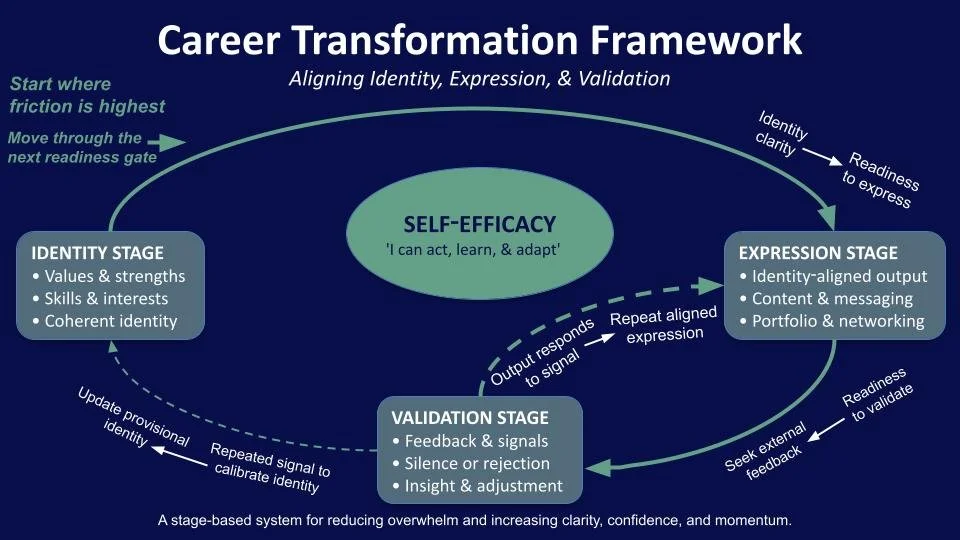
Most career frameworks fail operators in a predictable way: they reward decisiveness before comprehension. They treat motion as virtue, clarity as something you earn after execution, and constraint as a liability to be overcome rather than a signal to be interpreted.
For Operators: Reading the System Before You Act
The Career Transformation Framework (CTF) takes a different stance.
It assumes that careers behave less like ladders or linear pathways and more like complex systems—systems where early moves disproportionately shape downstream options, where noise can masquerade as opportunity, and where the costliest errors are often premature ones.
This essay is not a how-to. It is a way of holding the system—a mindset for operators who are used to acting, building, shipping, and optimizing, but who recognize that the same instincts that create momentum can also create irreversibility.
Operators are rarely stuck because they don’t know how to execute.
They are stuck because execution outruns interpretation.
Operators do not lack drive — they lack signal discipline
In the Career Transformation Framework (CTF), early stages are not about accumulating leverage; they are about reducing misinterpretation.
Signals arrive continuously—feedback from the market, from collaborators, from one’s own energy and resistance—but without a disciplined frame, these signals collapse into a single undifferentiated pressure to “do something.”
The Career Transformation Framework treats signal interpretation as a first-order activity.
Not every positive signal is directional. Not every negative signal is corrective. Some signals are diagnostic; others are boundary markers; others are simply noise amplified by proximity or recency.
Operators trained to optimize throughput often misread frequency as importance.
The CTF deliberately slows the impulse to interpret signal prematurely—not to suppress action, but to preserve optionality until the system’s contours are legible.
The most misunderstood aspect of the CTF is sequencing. It can appear conservative, even passive, to those accustomed to rapid iteration. In reality, sequencing is a protective measure against false convergence.
Sequencing is a form of risk management
Early convergence feels productive. It simplifies decisions, clarifies narratives, and reduces cognitive load. But premature convergence locks in assumptions that have not yet been stress-tested against the system.
The Career Transformation Framework assumes that timing matters as much as choice.
Certain questions—about identity, direction, or commitment—are only answerable after lower-level uncertainty has been reduced.
Attempting to resolve them early does not accelerate progress; it compounds error.
For operators, the CTF reframes patience not as waiting, but as active containment.
You are not delaying action; you are staging it.
In most professional contexts, constraints are framed as obstacles: limited time, limited clarity, limited authority, limited data. The instinct is to bypass them.
Constraints are not friction — they are guardrails
The Career Transformation Framework (CTF) treats constraints differently.
Constraints are protective structures that prevent irreversible moves before sufficient signal has been gathered. They narrow the action space not to restrict growth, but to prevent costly misalignment.
A constraint that forces you to run small experiments instead of large bets is not slowing you down; it is shielding you from narrative lock-in.
A constraint that limits external signaling (titles, public positioning, premature branding) is not hiding you; it is preserving your ability to change course without reputational drag.
Operators often pride themselves on pushing through constraints.
The CTF asks instead: “What is this constraint protecting me from right now?”
One of the more subtle risks for high-capacity operators is mistaking momentum for correctness.
Activity generates feedback; feedback generates reinforcement; reinforcement generates confidence.
None of this guarantees that the system is moving toward a stable or desirable attractor.
Momentum is not the same as direction
The CTF distinguishes between kinetic energy and directional alignment.
Early stages favor the latter. The goal is not to maximize motion, but to ensure that when motion compounds, it does so along a trajectory that remains viable under stress.
This is why the framework tolerates asymmetry: long periods of observation followed by decisive action; constrained exploration followed by rapid commitment.
From the outside, this can look uneven. From inside the system, it is deliberate.
What operators bring to the CTF is not speed, but an intuitive understanding of reversibility.
Experienced practitioners know which decisions can be undone cheaply and which cannot.
The framework formalizes this intuition and applies it earlier than most people are comfortable with.
The operator’s advantage is reversibility awareness
Early-stage career moves that appear reversible often aren’t—not because they are technically permanent, but because they shape identity, narrative, and future signal interpretation.
The Career Transformation Framework treats these soft irreversibilities with the same caution engineers reserve for hard ones.
This is not risk aversion. It is risk placement.
Acting later, acting cleaner
When action finally becomes appropriate in the framework, it tends to be cleaner than what preceded it.
Decisions are narrower, experiments are better scoped, and commitments are made with a clearer understanding of what is being traded away.
For operators, this can feel paradoxical: less premature action produces more decisive action later.
This is the central bet of the Career Transformation Framework (CTF):
Disciplined interpretation and constraint-respecting sequencing create conditions where action actually compounds, rather than merely accumulates.
The framework does not ask operators to stop operating.
It asks them to operate on the system itself before operating within it.
Where to begin
If this framing resonates, resist the impulse to move immediately to the CTF full manual.
The framework is stage-based.
Identity, Expression, and Validation address different bottlenecks, and beginning in the wrong stage often creates the very mis-sequencing the framework is designed to prevent.
The following diagnostic exists to determine whether this framework is relevant to you—and if so, where friction is currently highest.
Begin there. Work one stage at a time.
This short diagnostic helps determine whether the Career Transformation Framework is relevant to you—and if so, where friction is currently highest in your professional transition.
Diagnostic: Identifying your current bottleneck
It is not a personality test. It does not label you. It identifies sequencing bottlenecks.
To help you decide whether this framework might be relevant to you, answer the following questions for yourself. Answer honestly. You are not being evaluated. You are locating where to begin.
If most of these are true of you, the Career Transformation Framework may be helpful for you.
“I feel capable in my work, but currently stalled or misdirected.”
“I am willing to work through a structured process rather than seek quick tactical advice.”
“I can tolerate acting without certainty if the process is disciplined.”
“I am open to revising my professional stance over time rather than seeking immediate clarity.”
The following questions are designed to help you diagnose stage-based sources of friction in your career transition.
Diagnosing Identity-Stage friction
If most of these are true of you, you may be experiencing an Identity-Stage bottleneck.
“I struggle to articulate a clear professional stance I can stand behind publicly.”
“I feel pulled between competing versions of myself or directions.”
“Choosing a direction feels like closing off too many important options.”
“I hesitate to act because I do not feel sufficiently defined.”
Diagnosing Expression-Stage friction
If most of these are true of you, you may be experiencing an Expression-Stage bottleneck.
“I have a sense of direction, but I do not know what to express or ship first.”
“I generate ideas but rarely externalize them.”
“Every output feels high-stakes.”
“I refine privately instead of expressing publicly.”
Diagnosing Validation-Stage friction
If most of these are true of you, you may be experiencing a Validation-Stage bottleneck.
“I draw large conclusions from small amounts of feedback.”
“Silence feels like rejection.”
“I frequently revise direction after limited external response.”
“My confidence shifts significantly after sharing work.”
Guided Entry: Suggestions for Exploring the Career Transformation Framework (CTF)
If the diagnostic questions that resonate with you most are:
Identity bottlenecks → Begin with Identity Stage Resource Pack
Expression bottlenecks → Begin with Expression Stage Resource Pack.
Validation bottlenecks → Begin with Validation Stage Resource Pack.
If none of these resonate with you → You may not be mis-sequenced; the framework may not be your primary bottleneck. In this case, the framework may not match your current needs.
What This Framework Ultimately Builds
The Career Transformation Framework (CTF) is not designed to produce immediate clarity or rapid outcomes. It is designed to build something quieter and more durable.
Across Identity, Expression, and Validation, the framework builds self-efficacy — the felt capacity to act and remain in motion under uncertainty.
Identity builds a stance you can operate from.
Expression builds the willingness to externalize that stance.
Validation builds the discipline to interpret signal without collapsing.
Individually, each stage stabilizes one dimension of career transition. Together, the stages form a reinforcing system.
Identity without Expression becomes private conviction without test.
Expression without Identity becomes reactive performance.
Validation without discipline becomes judgment.
When sequenced correctly, each stage strengthens the next.
Identity introduces constraint so that action becomes possible.
Expression introduces public-facing artifacts so that learning becomes possible.
Validation introduces proportional interpretation of signal so that adjustment becomes possible.
The cycle then repeats — but with less volatility.
Progress in this framework does not first appear as outcomes. It appears as stability.
With stability you notice:
Less panic when choosing a direction
Less urgency to overexplain yourself
Less fragility when a signal is weak
Less temptation to globally revise identity after isolated feedback
Increased capacity
Increased willingness to express again
Increased precision in how you scope
Increased discernment in what feedback actually means
Increased steadiness between cycles
These are not cosmetic shifts. They are structural shifts.
Repetition compounds over time
Across cycles, the readiness gate between stages becomes easier to recognize.
With repetition:
Constraint becomes less threatening.
Outputs become less performative.
Silence becomes less catastrophic.
Looping back becomes procedural rather than emotional.
What changes is not that uncertainty disappears. What changes is that you can stay in motion inside it. The framework ultimately builds disciplined sequencing under pressure.
Managing uncertainty with the Career Transformation Framework (CTF)
The CTF replaces escalation with gating. It replaces panic with constraint. It replaces over-interpretation of signal with categorization. It replaces global identity revision with selective updating.
In early cycles, the system may feel effortful and deliberate. In later cycles, it feels familiar.
You begin to recognize:
“I am developing my provisional professional identity in the Identity Stage.”
“I am creating artifacts in the Expression Stage.”
“I am interpreting external signal in the Validation Stage.”
You stop confusing the stages with one another. And because you stop mis-sequencing across stages, confidence becomes less volatile and self-efficacy builds rather than deteriorates.
Self-efficacy is not produced by praise. It is produced by repetition.
Each complete cycle — even a small one — reinforces the belief:
“I can choose a stance.”
“I can express it.”
“I can interpret what happens.”
“I can adjust without unraveling.”
These are the core features of self-efficacy in the CTF.
These self-efficacy beliefs are the real outcome. Not certainty. Not perfection. Not permanent clarity.
The goal is ultimately to build self-efficacy. Self-efficacy supports durable motion under uncertainty.
The Career Transformation Framework (CTF) does not eliminate ambiguity. It teaches how to operate inside it without losing coherence.
Learn more about the Career Transformation Framework (CTF)
Curious to learn how I am building the CTF?
If everything you read here resonated with you strongly, you may be interested in the full working manual for the Career Transform Framework.
This is not the recommended first step for exploring the CTF — however I am providing it here for curious readers who want a deep dive into the framework.