
Career Transformation Framework (CTF): Validation Stage Resource
Diagnosing friction in signal interpretation without overwhelm
Prerequisites
1. You cleared the Identity Stage progression gate.
You have cleared this gate if you have a coherent professional identity anchor that:
feels slightly incomplete
excludes some paths
is revisable rather than fixed
You must be able to say your provisional identity anchor out loud in one sentence — first to yourself without cringing, then to others without apologizing.
If Identity still feels unstable, return there first.
2. You cleared the Expression Stage progression gate.
You are no longer thinking:
“I don’t know where to start.”
“Everything feels important.”
“What if I put the wrong thing out there?”
If Expression still feels overwhelming, return there first.
At this point, someone using the Career Transformation Framework (CTF) can:
Design expression without overwhelm
Ship aligned artifacts without overexposure
Protect their provisional professional identity during early validation
Build self-efficacy through repetition
Expression should feel effortful but steady — challenging, not identity-threatening.
This resource is for you if:
You have expressed something aligned:
You have shared, posted, applied, presented, or reached out
You are now receiving some signal — or nothing at all
You feel unsure how to interpret what is coming back
In the Validation Stage people can experience:
Heightened self-doubt after taking action
Temptation to draw large conclusions from small signals
Emotional swings between optimism and discouragement
An urge to abandon or radically change direction
If this resonates with you , you are in the Validation stage of the Career Transformation Framework.
That does not mean you are being judged.
In the Validation Stage signal is entering the system. Disciplined interpretation of signal is the key.
When not to use this resource
Validation is not about reassurance. It is about interpretation without destabilization.
This resource is not for:
Deciding who you are
Stabilizing a fragile identity anchor
Forcing optimism
Convincing yourself things are going well
If Identity still feels fragile, return there first.
Validation amplifies what already exists.
In the Career Transformation Framework, Validation is disciplined sensemaking.
Validation is not approval.
Validation is the structured interpretation of signal — including silence.
Key to the Validation Stage is interpretation discipline: Deciding what external signals in response to Expression artifacts do and do not mean, and the actions they do and do not justify.
What Validation is (and is not)
Validation is:
Categorizing feedback
Assessing signal quality
Separating learning from judgment
Deciding what to update and what to hold steady
Validation exists to produce learning — not reassurance.
Validation is not:
A verdict on your worth
A referendum on your identity
Proof that your direction is right or wrong
Something you pass or fail
In the CTF, validation is data — not meaning.
Why validation can feel destabilizing
Validation is the first time your internal work meets the external world.
At this stage:
Signals are often weak
Responses are ambiguous
Silence is common
Timing is misaligned
The nervous system wants resolution. The system does not yet offer it.
That tension is normal — and temporary.
Validation requires emotional steadiness — enough stability to interpret signals proportionally rather than globally.
The most common stall mode in the Validation Stage is global meaning-making — when a small signal is treated as a large conclusion.
What global meaning-making looks like when premature
Examples:
“No one responded — this is not working.”
“One person liked it — I chose the right path.”
“I was rejected — I misjudged who I am.”
“This did not land — I chose the wrong direction.”
When global sense-making is premature the problem is not the signal. The problem is scale.
Why premature global meaning happens:
Early signals are emotionally loud
Identity is still stabilizing
Repetition has not occurred
The system wants certainty quickly
Premature global meaning happens because the mind attempts to close the loop prematurely.
But early Validation signals must not carry that much meaning.
The corrective principle
In the CTF no single signal is allowed to update identity.
Identity updates only after:
Repeated signals
Contextual interpretation
Pattern recognition across time
Validation informs next steps. It does not redefine who you are.
The core skill in Validation is categorization.
Before asking “What does this mean?”, ask: “What type of signal is this?”
Signal categories
Signals differ in quality, timing, and scope. Treating them as equivalent destabilizes the system.
Category 1: Early vs. late signals
Early signals:
First responses
Small numbers
Quick reactions
Partial engagement
Silence shortly after expression
Early signals are:
Emotionally loud
Informationally weak
Early signals are useful for:
Detecting basic alignment
Identifying friction
Informing small adjustments
Early signals are not useful for:
Judging direction
Evaluating identity
Deciding whether to stop
Late signals:
Repeated patterns
Sustained engagement
Compound responses
Invitations or follow-ups
Late signals are:
Quieter
More reliable
Slower to appear
Identity-level learning and updates should only be informed by late signals.
Category 2: Signal vs. noise
Not every response is signal.
Noise includes:
Out-of-context reactions
Responses from unintended audiences
Platform artifacts
One-off opinions
Timing-related absences
Signals are:
Aligned with intended audience
Repeatable across expressions
Connected to the purpose of the signal
Pointing to an actionable step
If you cannot act on an external response, it is likely noise.
Category 3: Tactic-level vs. identity-level feedback
Distinguishing between tactic-level and identity-level feedback protects self-efficacy.
Tactic-level feedback:
Clarity
Format
Framing
Delivery
Timing
Most early feedback is tactic-level — even when it feels personal.
Treating tactic feedback as identity feedback destabilizes confidence.
Identity-level feedback:
Role fit
Problem selection
Value alignment
Direction over time
Validation does not require updating everything. It requires updating only what the signal can support.
The selective-update rule
Belief updates must be proportional to signal strength. If the signal is small, the update should be small.
For any signal, ask:
“What is this feedback actually about?”
“What level does it belong to?”
“What is safe to update — and what is not?”
Then update only that layer.
Early in the Validation Stage, it is appropriate to update:
Tactics
Sequencing
Clarity
Audience assumptions
Expression constraints
Early in the Validation Stage it is not appropriate to update:
Professional identity anchors
Long-term direction
Core capability beliefs
Self-worth
Those updates require patterned evidence across time.
When Identity updates are warranted
Identity-level updates become appropriate when:
Signals repeat consistently
They come from intended audiences
They persist across different expressions
They align with lived experience
Until then, identity remains anchored.
Large emotional reactions to small signals are usually a sign that interpretation — not identity — needs further definition and support.
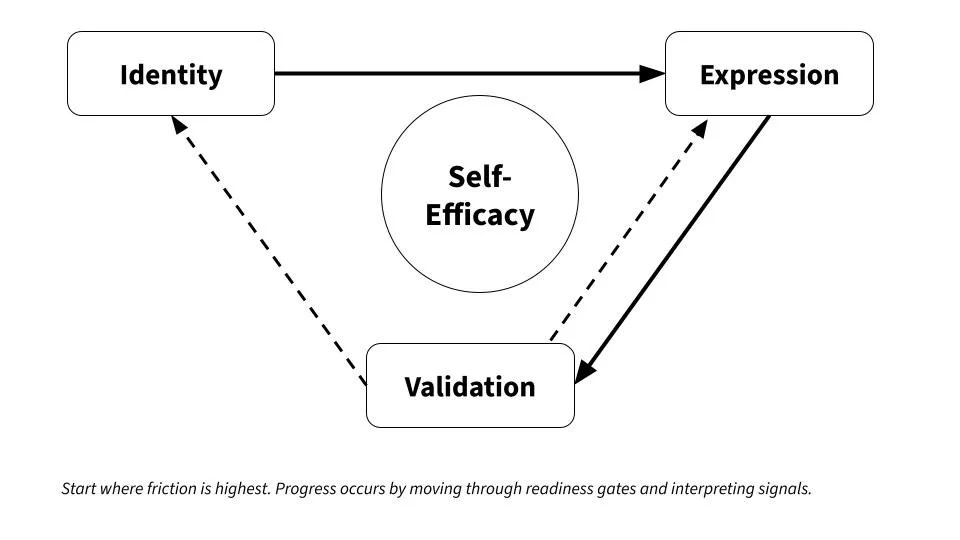
When to continue vs loop back
Eventually, validation produces enough learning that the system must choose its next move.
There are two options:
Continue (repeat or amplify)
Loop back (adjust Identity or Expression)
Looping back means returning to a prior stage to recalibrate constraints or stance before escalating.
A loop back is not regression. It is disciplined recalibration.
Continue when:
Signals align with identity
Stability increases
Feedback clarifies rather than destabilizes
The next test is obvious
Loop back when:
Repeated signals contradict identity
Expression feels misaligned despite iteration
Anxiety increases rather than stabilizes
Minor data is being over-interpreted
A healthy loop feels:
Informative, not threatening
Clarifying, not overwhelming
Directional, not final
The Career Transformation Framework moves through appropriate cycling — not escalation.
Where this completes the Validation Stage
Validation is not the end of the process.
It is the stage that teaches you how to stay in motion without losing yourself.
When done well:
Identity becomes more resilient
Expression becomes more precise
Confidence compounds quietly
Self-efficacy stabilizes earlier in each cycle
The goal of the Career Transformation Framework is not approval — it is durable motion under uncertainty.
Validation Stage: Worked Example
Purpose
This example demonstrates how validation signals are interpreted without destabilizing identity. It shows how categorization and proportional updating allow learning without premature conclusions.
1. Starting state: Expression friction
After producing several aligned artifacts, the individual began receiving mixed responses.
Some signals included:
A small number of thoughtful replies
A few strong resonances from the intended audience
Silence from other channels
Occasional feedback focused on presentation rather than substance
Emotionally, these signals were loud.
It was tempting to draw large conclusions from them.
2. Interpreting early signals
The first step was recognizing that most responses were early signals.
Early signals were characterized by:
Small numbers
Partial engagement
Unclear patterns
Mixed relevance
Rather than asking “Is this working?”, the individual asked:
“What category of signal is this?”
This shift prevented premature global conclusions.
3. Categorizing signal vs noise
Signals were categorized into three groups.
Early signals
Initial responses from thoughtful readers
Limited but meaningful engagement
These indicated basic alignment but were too small to support large conclusions.
Noise
Responses from unintended audiences
Platform artifacts or superficial reactions
These were acknowledged but not weighted heavily.
Tactic-level feedback
Suggestions about clarity or framing
Questions about specific examples
These indicated areas where Expression could improve without revising identity.
4. Selective updating
Using the selective update rule, only the layer supported by the signal was updated.
Appropriate updates included:
Refining how ideas were explained
Adjusting structure to clarify key concepts
Emphasizing examples where readers found them helpful
Identity-level beliefs remained unchanged.
The signals were informative, but not yet patterned enough to update direction.
5. Continue vs loop back decision
After several signals were observed, the system evaluated whether to continue or loop back.
Indicators supported continuing Expression:
Responses came from the intended audience
Stability increased rather than decreased
Feedback clarified rather than contradicted identity
Repetition felt productive
No loop-back was necessary.
Expression continued under the same identity anchor.
6. What changed
Over time:
Emotional reactions to individual signals decreased
Pattern recognition improved
Feedback became easier to categorize
Identity remained stable while tactics evolved
The system became less reactive and more interpretive.
In the CTF, this is what progress looks like in Validation.
Validation Stage Complete.
Learn More About the Career Transformation Framework (CTF)
The Career Transformation Framework is in ongoing development. I welcome your feedback.