
The Career Transformation Framework (CTF):
Full Working Manual
A systems approach to navigating uncertainty during career transitions
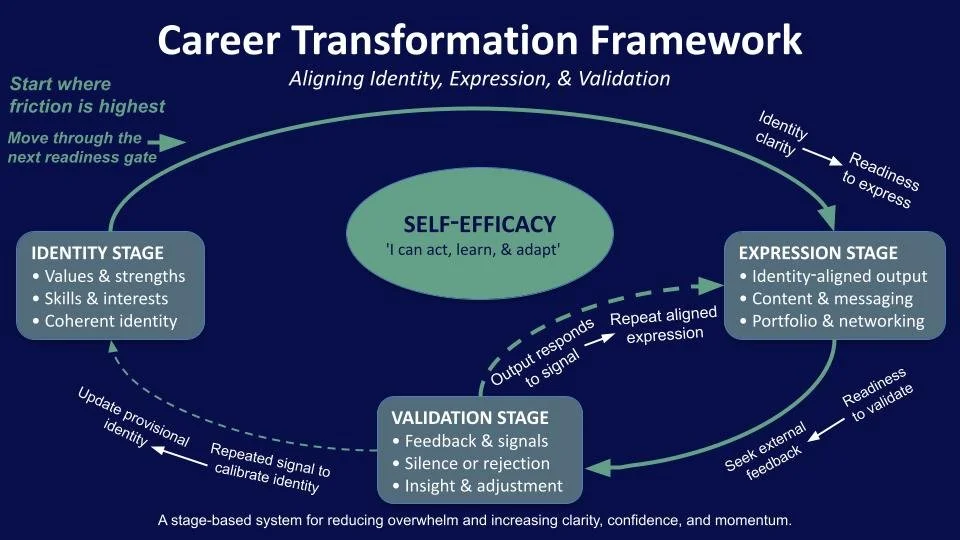
How to use the Career Transformation Framework (CTF)
Do not begin by reading the entire manual.
1. Start with the diagnostic.
The framework is stage-based.
Identity, Expression, and Validation address different bottlenecks.
Beginning at the wrong stage often recreates the very mis-sequencing the framework is designed to prevent.
Use the diagnostic to identify where friction is currently highest. Begin there.
You can find the CTF Self-Diagnostic on the Career Transformation Framework (CTF) main page. Scroll about halfway down and look for:
Diagnostic: Identifying your current bottleneck
2. Work one stage at a time.
Move through the framework sequentially:
Identity → Expression → Validation
Each stage has a readiness gate.
Do not advance simply because you have finished reading a section.
Advance only when:
Alignment feels stable
Constraint is clear
Willingness replaces panic
If anxiety increases, reduce scope.
3. Treat the Career Transformation Framework (CTF) as cyclical.
The CTF is not a checklist. It is a cycle.
Complete one full cycle before escalating stakes.
Loop back when:
Signal contradicts your stance
Expression feels forced
Feedback destabilizes disproportionately
Scope escalates prematurely
Looping back is recalibration, not regression.
4. What progress looks like in the CTF
In the Career Transformation Framework, progress is not measured first by outcomes.
Early indicators include:
Reduced panic
Clearer articulation
Increased willingness to express again
More disciplined constraint
Improved signal interpretation
Outcomes may lag. Stability precedes visibility.
5. When to Escalate
Escalate scope only when:
Expression feels repeatable
Validation patterns emerge
Identity remains stable under signal
If these are not present, tighten constraint before expanding.
6. When to Pause
If the system feels frantic:
Reduce scope.
If it feels stagnant:
Increase clarity.
If it feels overwhelming:
Return to Identity.
The progression goal in the CTF is durable motion under uncertainty, not constant output.
7. Executive Summary
The Career Transformation Framework (CTF) is a sequencing architecture for operators navigating professional transition under uncertainty.
It is not a collection of job-search tactics or a motivational guide.
The CTF is a structured model for stabilizing identity, producing aligned signal, and interpreting feedback without destabilization.
Career transition is the initial use case, not the category boundary.
The problem the CTF addresses
Most professional advice assumes clarity precedes action and action precedes reward.
In practice, capable people often stall not because they lack skill or drive, but because they mis-sequence identity, expression, and validation.
Common breakdowns include:
Acting before identity stabilizes
Over-interpreting early feedback
Seeking validation prematurely
Revising direction based on isolated signal
Escalating scope before readiness
These patterns compound volatility and erode self-efficacy.
The CTF addresses sequencing under pressure.
The stage-based model for the Career Transformation Framework
The CTF moves through three gated stages:
Identity → Expression → Validation
Identity stabilizes a provisional professional stance under constraint.
Expression translates that stance into observable, aligned signal.
Validation interprets signal proportionally and determines whether to continue or loop back.
Movement between stages is conditional. Each transition requires readiness, not momentum.
The model is cyclical. Looping back is recalibration, not regression.
What the CTF builds
The primary outcome of the Career Transformation Framewowrk is durable self-efficacy — the capacity to act and remain in motion under uncertainty without collapsing confidence.
Early progress appears as:
Reduced panic
Clearer articulation
More disciplined constraint
Improved signal interpretation
Outcomes may lag. Stability precedes visibility.
The framework is stage-based. Users begin by identifying where friction is currently highest. Each stage can be engaged independently once the bottleneck is clear.
The full manual provides detailed guidance, but the model itself is intentionally simple.
The CTF does not eliminate ambiguity. It structures how to operate within it.
Curious to learn how I am building the CTF?
The Career Transformation Framework is in ongoing development. I welcome your feedback.