
I am a systems-oriented operator and researcher working at the intersection of data, decision-making, and uncertainty.

Strategic Operations | Business Operations | Decision Systems | Cross-functional Execution
My work focuses on making complex systems legible so action can be sequenced deliberately rather than reactively - even when uncertainty is high.
Professional Background
Experience across agency, research, and independent analytical contexts.
Across roles in revenue analytics, operational diagnostics, and research environments, I have consistently focused on identifying where friction lives in a system and designing structures that allow decisions to hold under pressure.
Whether analyzing revenue dynamics, mapping research programs, or modeling professional transition, my approach is the same: identify stage, diagnose constraint, respect signal, and sequence intervention.
Core skills:
Diagnosing signal distortion and revenue friction
Modeling system behavior across time and pathways
Designing structured inquiry under uncertainty
Enabling cross-functional execution
Current Focus
Open to strategy and systems-oriented roles.
I am interested in how integrative thinking and disciplined sequencing improve outcomes under uncertainty. I build models and decision architectures that clarify direction when ambiguity is high and stakes are real.
I am especially interested in organizations building platforms that help teams interpret complex systems — whether in analytics infrastructure, research tooling, or climate intelligence. I’m particularly well-suited to early-stage and scaling organizations where systems are evolving and decision clarity is critical.
For professional inquiries, I can be reached via Email or LinkedIn.
In My Spare Time
I enjoy exploring systems thinking through writing, field observation, and applied modeling projects. I am drawn to environments where ambiguity is high and structure must be built rather than assumed. I often turn to observing natural systems to refine how I think about complexity, constraint, and change.

A flooded backyard became an unexpected lesson in how complex systems change — teaching me that constraint, diagnosis, and time reshape outcomes more reliably rather than force.
Sometimes the most durable solutions begin with observation rather than action.

Sometimes reflection takes the form of writing — a way to slow observation and notice what structure reveals over time.
Observation precedes intervention.
Patience reveals structure.
Many problems look different when experienced at the pace they unfold.
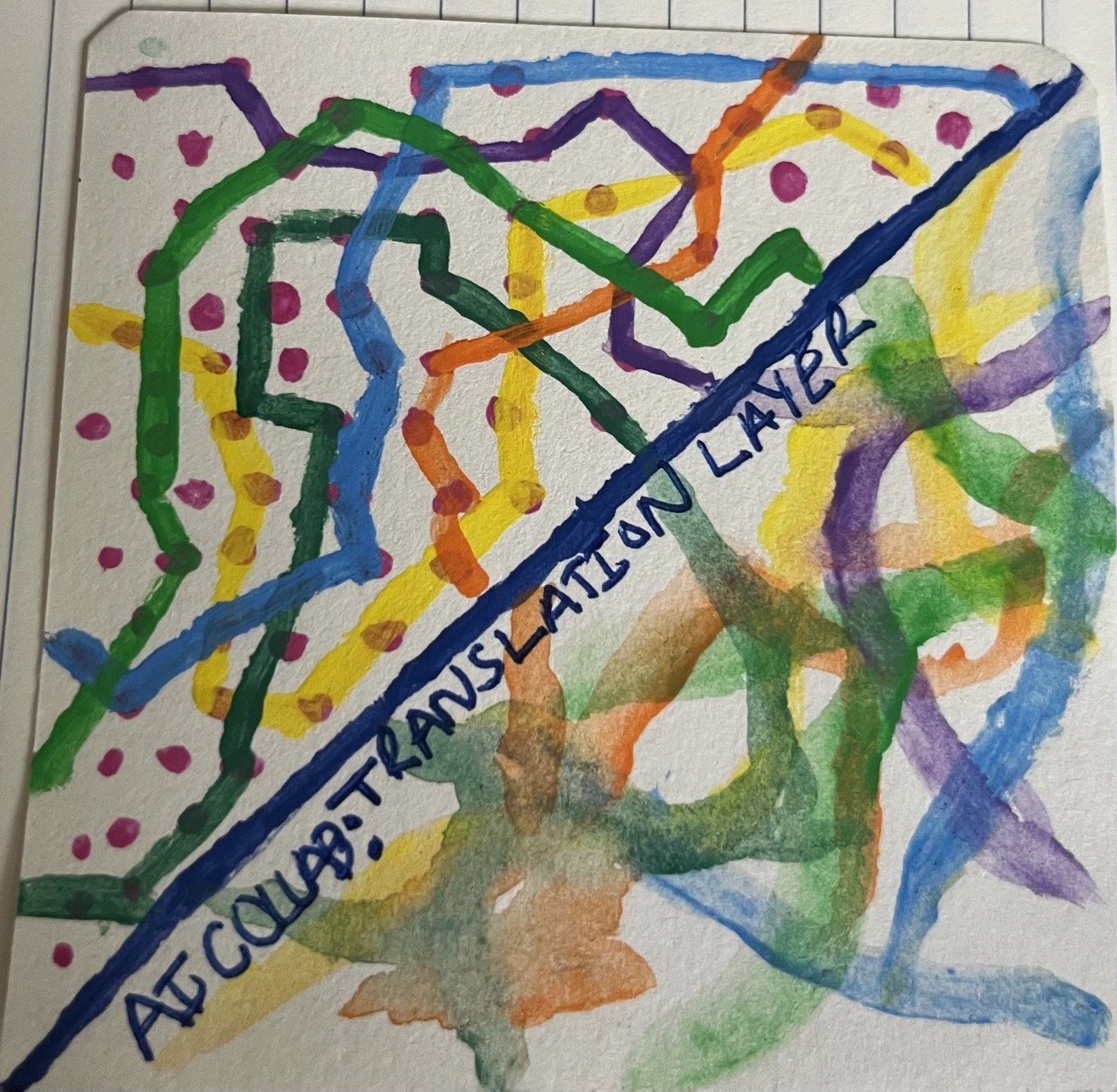
Sometimes systems thinking shows up before language does. In painting, I often begin without a plan and only later recognize the structure emerging — connections, boundaries, and translation layers taking shape before they are named.
This piece became a visual model of how structured reasoning emerges from layered complexity.