
When Art Reveals How Thinking Becomes Structured
A visual model of how structured reasoning emerges from layered signal
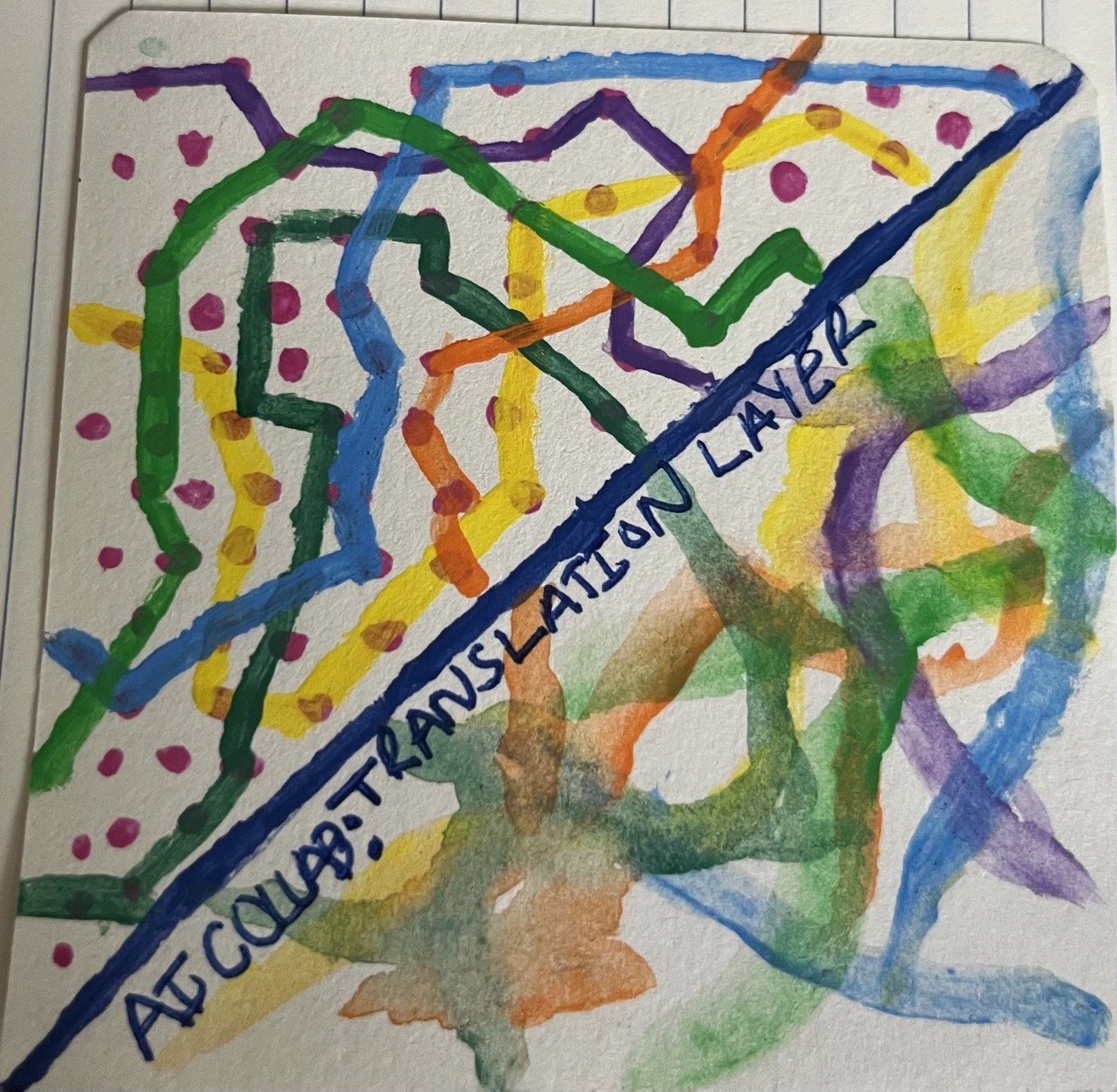
I began this painting without a clear plan.
I had a rough sense of direction, but the structure emerged only through the act of building it. It wasn’t until the final strokes were complete that I recognized what the image represented.
This piece became a visual expression of something I experience regularly in my work: the movement from raw signal to structured reasoning — and the role of constraint in making complexity legible.
What emerged on the canvas reflected what thinking across systems often feels like before it becomes formal structure. Layered signals. Emerging patterns. Selective connections. The process of painting reflected how I use AI systems for collaborative thinking – not as an answer generator, but as a translation layer between complexity and clarity. A way of making operational reasoning visible before it is fully named.
AI as a Translation Layer
The most defining feature of the painting is the diagonal boundary that cuts across the canvas.
It is not a wall, and it is not a separator. It behaves more like a membrane. Something that allows movement but transforms what passes through it.
On one side, color spreads freely. Layers blend, bleed, and overlap. The movement feels fluid, unresolved, and exploratory. Not chaotic but without clarifying structure. This side represents raw signal: experiences, inputs, partial patterns, and fragments of information that have not yet been organized into meaning.
On the other side, dots begin to appear. Then selective connections emerge. The lines form pathways between some points but not others. Structure develops gradually, not all at once. Some ideas connect. Others remain independent. Parallel lines form. Occasionally they cross.
The diagonal boundary makes this transformation possible.
It does not create clarity directly. Instead, it establishes the condition under which clarity can emerge. It creates the structure that allows raw signal to become interpretable signal.
This is the role I associate with effective AI collaboration. Not as a tool for generating finished answers or automation that replaces thinking, but as a mechanism for translation that helps move between raw signal, structured reasoning, and actionable decision.
Process: Defining Constraint Before Content
Most people begin by defining content. I began by defining constraint.
The first mark on the canvas was the diagonal boundary. The structure came first. Before color, before shape, before detail. That line established the condition that would organize everything that followed.
Once the boundary existed, the rest of the painting unfolded in stages.
On the fluid side, layered watercolor washes came next. Colors blended, overlapped, and stretched toward the boundary. The movement felt like pressure building. Signals accumulated without yet becoming fully interpretable. Not chaos, but unresolved structure.
On the structured side, dots appeared first. Individual fragments emerged without immediate connection. Each dot represented a possible idea, hypothesis, or signal. Those individual elements were present, but not yet integrated into a larger system.
Only after those fragments existed did connections begin to form. Lines were added selectively. I linked some points while leaving others independent. Parallel paths emerged. Some crossed. Some remained isolated.
Not every idea needed to connect immediately.
Some signals remained unresolved. Not because they lacked value, but because forcing connections too early often creates noise instead of clarity.
This sequence — constraint first, signal second, structure third — reflects how many durable systems are built. Not by forcing order prematurely, but by creating conditions where meaningful structure can emerge over time.
Translating Complexity Without Replacing It
The process of painting this piece revealed something I’ve come to recognize across many forms of structured thinking: clarity does not emerge by removing complexity. It emerges by learning how to move through it.
The diagonal boundary did not eliminate ambiguity. The fluid side remained layered and unresolved. The structured side remained selective, incomplete, and adaptive. The goal was never total connection. It was navigable structure.
That distinction matters in both human reasoning and AI collaboration.
When complexity is forced into premature structure, noise increases rather than clarity. Connections made too early often reflect assumptions rather than understanding. Systems built this way may appear orderly at first. But they tend to break under pressure when they are assembled before signal fully emerges.
In contrast, durable systems allow complexity to exist long enough to reveal its own patterns. They do not attempt to simplify everything immediately. Instead, they translate between layers. They help move information from raw signal toward structured interpretation. They preserve the context that makes that structure meaningful.
This is the role I associate with effective AI collaboration.
Not as a tool for generating finished answers.
Not as automation that replaces thinking.
But as a mechanism for translation — systems that help move between raw signal, structured reasoning, and actionable decision.
Structured thought does not erase complexity.
It cuts through it.
And the strength of that structure depends not on how much is connected, but on how deliberately connections are made.
Permission for Disconnection
I didn’t just paint connections.
I painted permission for disconnection.
Most diagrams — and most reasoning — attempt to connect everything immediately. There is a tendency to resolve uncertainty quickly, to force patterns into place before their structure has fully emerged.
But leaving some points unconnected creates space for curiosity. It preserves the possibility that meaning will evolve later, rather than being fixed too early.
In the painting, some dots remain independent. Some pathways run in parallel without intersecting. Others cross briefly before continuing in different directions. The structure is not incomplete. It is intentionally selective.
That selectivity reflects how durable systems are built. Not by connecting everything at once, but by allowing patterns to develop gradually and linking signals only when relationships become meaningful.
The diagonal boundary still behaves like a membrane. It allows movement, but transforms what passes through it. Structure does not eliminate uncertainty. It creates conditions where uncertainty can be explored without becoming overwhelming.
In that sense, this painting reflects more than a single moment of creative expression. It reflects a working principle I return to often:
Structured thought does not erase complexity. It makes movement through complexity possible.