
Career Transformation Framework (CTF): Identity Stage Resource
Diagnosing and resolving friction in professional identity development
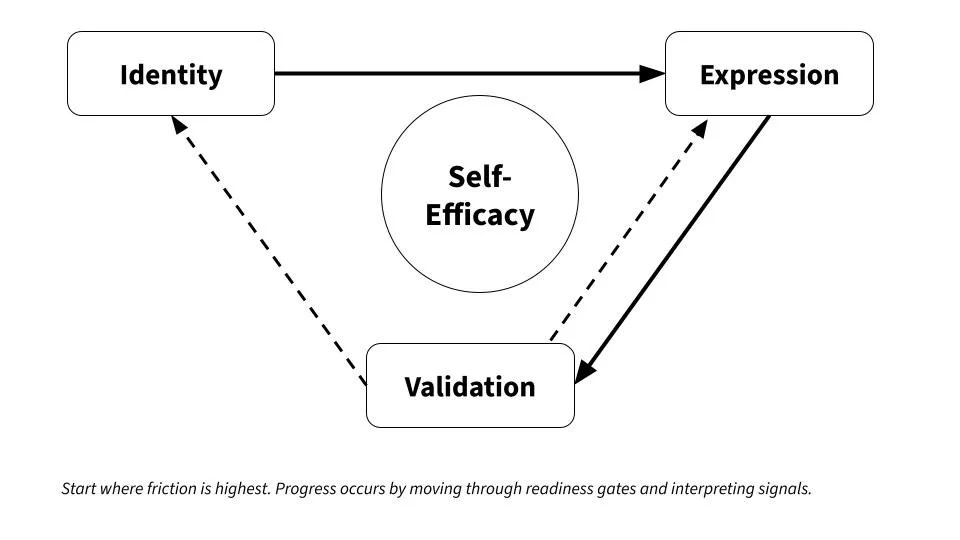
This resource is for you if:
You are capable, experienced, and reflective — but feel undefined
You are in a major career transition and don’t know how to describe yourself
You feel pressure to act, but don’t feel ready to choose a direction
You are looping on questions like:
“What should I be doing next?”
“How do I explain myself without overcommitting?”
“What if I choose wrong?”
If any of those feel true, you’re likely stuck in the Identity stage of the Career Transformation Framework. That’s not a failure. It’s a signal that professional identity alignment hasn’t stabilized yet.
When not to use this resource
This resource is not for:
Fine-tuning a clear professional identity
Optimizing an already-working career strategy
Rebranding for performance or visibility
Forcing clarity under time pressure
If you already feel grounded and ready to act, Identity-Stage work may not be your bottleneck right now. The CTF works by starting where friction is highest.
In the Career Transformation Framework, identity work is not about discovering your “true self.” It is about reaching a level of alignment between personal and professional identity.
Constraints make action possible without draining you.
What “counts” as Identity-Stage work
Here, identity is treated as provisional and functional, not fixed or performative. It is a stance you can operate from for this cycle.
Identity work includes actions that help:
Clarify what matters enough to constrain choices
Reduce internal contradiction
Name tradeoffs you are willing — and unwilling — to make
Reach readiness to express, not certainty about outcomes
What does not “count” as Identity-Stage work
Identity work is not:
Endless self-reflection
Excavating personal history
Designing a personal brand
Imagining ideal futures without tradeoffs
Waiting to “feel confident” before deciding
Those activities can feel productive, but they do not move the system forward.
In the CTF, identity stabilizes through use, not introspection alone.
The goal of Identity-Stage work
The goal is not to answer: “Who am I, really?”
The goal is to answer: “Who am I choosing to be for now, given real constraints?”
Most people stuck in Identity are not confused — they are internally inconsistent. They are trying to hold multiple identities, values, or futures simultaneously, often because each feels protective or important.
The first step is not choosing an identity. It is diagnosing contradiction.
That answer only needs to be:
Coherent
Actionable
Revisable
That is enough.
Starting with a different question
Instead of asking: “Who am I?”
Ask: “Where am I pulling myself in opposite directions?”
None of these tensions are wrong. But trying to honor all of them at once makes action impossible.
Common forms of internal contradiction:
Wanting stability and radical change
Wanting meaningful work and minimal risk
Wanting recognition without visibility
Wanting to keep all options open while feeling stuck
Why contradiction matters
Reducing contradiction does not eliminate values. It prioritizes them temporarily.
Internal contradiction creates:
Hesitation
Second-guessing
Emotional exhaustion
Fragile confidence
Not because you lack clarity — but because no action can satisfy competing demands simultaneously.
How to reduce contradiction (gently)
At this stage, you are not committing to a permanent future. You are introducing enough constraint to move.
You do not need perfect answers. You need honest ones.
Helpful prompts:
“Which tension is costing me the most energy right now?”
“If I had to disappoint one version of myself, which would I choose?”
“What am I protecting by not choosing — and is it still serving me?”
“What would become impossible if I moved forward with clarity?”
A grounding reminder
Reducing contradiction often feels uncomfortable — not because you are doing it wrong, but because you are doing it for real.
Clarity always excludes something. In the CTF, that exclusion is not loss. It is the beginning of self-efficacy — the felt capacity to act and stay in motion under uncertainty.
Once contradiction is visible, the next step is to introduce constraint. Constraint means intentionally narrowing scope (time horizon, role family, problem type, environment) so that action becomes safe and testable.
Constraint is not commitment. It is scaffolding. It narrows the field just enough for clarity to emerge.
You are not choosing forever. You are choosing for now.
Optional pause point for reflection:
Before moving on, ask:
“Do I feel slightly more grounded than when I started?”
If yes, continue.
If not, slow down. That is information, not failure.
What constraint does
Without constraint, identity work stays abstract. With too much constraint, it becomes threatening. The goal is just enough. You do not need to constrain everything at once.
Safe forms of constraint:
Time horizon
“For the next 6–12 months…”
Role family (not job title)
“Roles centered on research, synthesis, and decision support…”
Type of problem
“Problems involving ambiguity, systems, or interpretation…”
Environment constraints
“I will not tolerate X; I need at least Y to function well.”
These constraints do not lock you in. They simply make some paths temporarily impossible — which is what creates clarity.
Constraint:
Reduces the number of identities you are trying to honor
Makes tradeoffs explicit
Lowers cognitive load
Creates conditions where self-efficacy can develop
Managing discomfort in constraint
If constraint feels overwhelming that usually means the constraint is too broad, or too many constraints are being introduced at once.
If panic appears:
Loosen scope
Shorten time horizon
Remove performance expectations
Constraint should feel slightly uncomfortable — not paralyzing.
With constraint in place, you are ready for a provisional identity anchor.
This is not a brand statement. It is not a headline. It is not who you are “at your best.”
A professional identity anchor is one sentence that is good enough to act from.
Importance of a provisional identity anchor
A strong provisional anchor:
Constrains choices
Guides expression
Reduces second-guessing
Stabilizes confidence during early validation
A provisional identity anchor gives you somewhere to stand while you test.
How to develop an identity anchor
A simple structure:
“I am someone who [core capability] in order to [type of outcome], in contexts where [constraint].”
Illustrative examples:
“I am someone who turns complex information into clarity for decision-makers in ambiguous environments.”
“I am someone who designs systems that reduce uncertainty for teams navigating change.”
Your provisional identity anchor does not need to be impressive. It needs to be usable.
A strong provisional identity anchor must:
Feel slightly incomplete
Exclude some paths
Be revisable rather than fixed
You must be able to say your provisional identity anchor out loud — first to yourself without cringing, then to others without apologizing.
If it feels perfect, it is probably too abstract. If it feels rigid, it may be overly constrained.
You are aiming for workable. Not perfection.
Quick self-check (optional)
Say your provisional identity anchor out loud to yourself.
Then, ask:
“Would this help me decide what to try next?”
“Would this help me decide what not to do?”
If yes, it is strong enough.
Readiness for Expression-Stage work
Before moving into the Expression Stage, use a readiness gate — a simple conditional check that prevents premature escalation.
You do not need confidence yet. You need alignment and willingness.
You are ready when:
You can choose what not to pursue right now
You can name a direction without spiraling
You feel capable of trying something small and aligned
You trust your identity can evolve through use
This does not feel like certainty. It feels like grounded willingness.
If you are not ready to proceed to Expression-Stage work that is not failure.
Feeling that you are not ready for Expression-Stage work usually means:
Constraints need tightening or loosening.
Contradiction has not fully reduced.
The provisional identity anchor is still too vague.
Instead of rushing to Expression, loop back gently:
Refine constraint
Revise the anchor
Lower stakes
Looping back is recalibration — not regression.
The framework moves by restoring readiness, not forcing progress.
Where this completes the Identity Stage
At this point, someone who was stuck in Identity should feel:
Less fragmented
More grounded
Capable of choosing a small next action
Protected from premature overexposure
That is the goal.
Expression comes next — not as escalation, but as continuation.
Identity Stage: Worked Example
Purpose
This example demonstrates Identity work in practice before applications, offers, or external validation. It demonstrates readiness — not success.
1. Starting state: Identity friction
The individual had strong capabilities but struggled to articulate a coherent professional stance.
Friction showed up as:
Pigeonholing into narrow labels
Decision fatigue
Difficulty explaining fit
Dread about acting without clarity
They lacked alignment under constraint — not skill.
2. Diagnosing contradiction
Competing pulls included:
Strategic influence vs. hands-on work
Mission vs. practicality
Keeping options open vs. feeling overwhelmed
Deep thinking vs. staying in perpetual learning
Each tension was rational. Together, they prevented decisive action.
3. Introducing constraint
Constraint was introduced as a thinking tool.
Stabilizing constraints:
Defined time horizon
Narrowed role family
Explicit non-negotiables
Clear exclusions
Clarity emerged because some paths were intentionally made impossible.
4. Provisional anchor
“I work at the intersection of research, systems, and operations to help teams make better decisions under uncertainty.”
This anchor:
Constrained action
Clarified what to express
Provided a stable reference point
It was revisable. Its purpose was usability, not permanence.
5. Readiness signals
Proceeding to Validation required:
Comfort narrowing before acting
Ability to explain direction calmly
Willingness to build aligned artifacts
Reduced second-guessing
Identity was no longer fragile. The system was ready to move.
6. What changed
Before any outcomes:
Decision fatigue decreased
Dread softened
Energy returned
Uncertainty became tolerable
These were stabilization signals. In the CTF, this is what progress looks like in Identity.
Identity Stage Complete.
Learn More About the Career Transformation Framework (CTF)
To continue exploring the CTF in sequence, move to the Expression Stage Resource next.
The Career Transformation Framework is in ongoing development. I welcome your feedback.