
Career Transformation Framework (CTF): Expression Stage Resource
Diagnosing and resolving friction in identity-aligned output creation
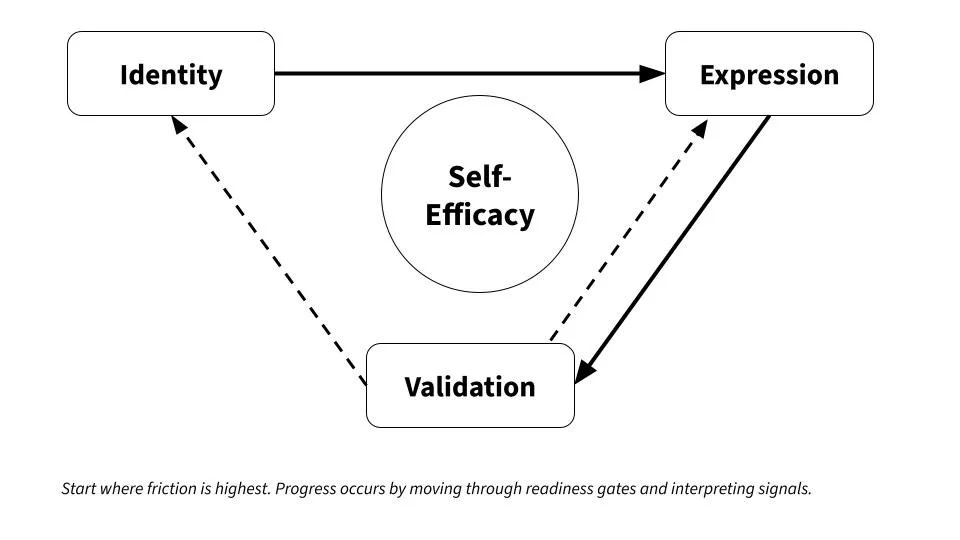
Prerequisite: You have a strong provisional identity anchor
A strong provisional identity anchor must:
Feel slightly incomplete
Exclude some paths
Be revisable rather than fixed
You must be able to say your provisional identity anchor out loud in one sentence — first to yourself without cringing, then to others without apologizing.
This resource is for you if:
You have a clearer sense of who you are and what you want to work toward
You feel capable of acting, but do not know what to express first
You have ideas, skills, or material — but feel blocked, scattered, or overwhelmed
You keep thinking:
“I don’t know where to start.”
“Everything feels important.”
“What if I put the wrong thing out there?”
If this feels familiar, the issue is likely Expression — not Identity. You are not lacking clarity. You are lacking constraint and sequencing.
When not to use this resource
This resource is not for:
Discovering who you are
Choosing a long-term direction
Stabilizing a fragile identity anchor
Producing high-volume content or visibility
Fine-tuning a clear professional identity
Optimizing an already-working career strategy
Rebranding for performance or visibility
Forcing clarity under time pressure
If Identity still feels unstable, that is okay. Return there first.
Expression amplifies what already exists — it cannot stabilize identity on its own.
Expression through public-facing artifacts
In the Career Transformation Framework, Expression is externalized signal through public-facing artifacts.
An artifact is any observable output that allows the external world to respond — even weakly or ambiguously.
Expression is translating internal readiness into one visible artifact that someone else can respond to.
Expression is not:
Preparation
Learning
Private drafting
Visibility for its own sake
The Expression Stage is about shipping public-facing artifacts that are aligned with a coherent professional identity.
What “counts” as Expression-Stage work
Here, expression is:
Intentional
Constrained
Aligned with identity
Designed to be interpreted
An artifact produces externalized public signal — not outcomes.
The form matters less than the alignment.
Examples of artifacts (non-prescriptive):
A short piece of writing
A project artifact
A portfolio element
A structured conversation
A public question
An outreach message
Without Expression:
Identity remains theoretical
Self-efficacy stays fragile
Validation cannot occur
Why the Expression Stage matters
Most people stuck in Expression are not afraid of being seen.
They are overwhelmed by too many possible signals.
Overwhelm, confidence volatility, and avoidance show up as:
Dozens of ideas and no starting point
Endless refinement without shipping
Switching formats or platforms repeatedly
Avoidance disguised as “not ready yet”
The issue is not fear of Validation signals. It is lack of constraint.
But Expression too early — or without constraint — creates the opposite problem:
Overwhelm
Confidence volatility
Avoidance of validation
The purpose of this stage is to make Expression safe enough to repeat.
Why lack of constraint stalls the Expression Stage
When Expression is unconstrained:
Every output feels high-stakes
Confidence never stabilizes
Self-efficacy cannot develop
If anything could be expressed, then nothing feels safe to express.
This is why generic “just post” advice fails for capable, reflective people.
What constraint does in the Expression Stage
Constraint reduces the number of possible actions before it reduces scope.
Constraint:
Lowers emotional stakes
Protects identity during early exposure
Makes repetition possible
Allows confidence to be earned gradually
Constraint is not limitation. It is scaffolding.
Expression becomes possible not when you know what to say.
It becomes possible when you know what is safe and aligned enough with your provisional professional identity to say right now.
Once Expression is identified as the bottleneck, the next move is not escalation. It is constraint.
Constraint means intentionally narrowing scope (audience, purpose, sequencing, or stakes) so that expression becomes psychologically safe and testable.
Escalating prematurely risks volatile changes in self-efficacy.
Why Expression needs constraint
Without constraint:
Every artifact feels like a referendum on identity
Every decision feels permanent
Self-efficacy collapses under pressure
With constraint:
Stakes are lowered
Choices become legible
Repetition becomes possible
The goal is not to find the best expression. It is to find a safe first public-facing artifact.
Types of stabilizing constraint
Constraint reduces emotional load before it reduces scope.
You only need one to start.
You can widen later. Right now, the job is to make Expression repeatable.
Examples of constraint:
Audience constraint: “This is for one specific type of person.”
Purpose constraint: “This signal exists to test one idea.”
Sequencing constraint: “This comes before anything else.”
Stakes constraint: “This is low-risk and revisable.”
What makes an artifact aligned
With constraint in place, you are ready to design a first aligned artifact.
An artifact is not performance. It is an invitation for response.
An aligned artifact meets three conditions:
It reflects your provisional identity anchor.
It fits inside your chosen constraint.
It is small enough to repeat.
Artifacts are meant to be iterated — not admired.
If you could not reasonably do it again next week, it is too large.
How small is small enough
A first aligned artifact is small enough that:
You do not need permission.
You do not need consensus.
You do not need confidence in the outcome.
If you feel the urge to:
Justify it
Over-explain it
Perfect it
Shrink the scope — not the idea.
What a first aligned artifact is not
To protect self-efficacy, name this clearly:
A first artifact is not:
Your manifesto
Your origin story
Your entire body of work
Proof that you are ready
A first artifact is simply: “Something aligned that I am willing to let be seen.” That is enough.
Before exposing work to validation, use a readiness gate. A readiness gate is a simple conditional check that prevents premature escalation. You are ready to validate when willingness replaces fear.
Signals that you are ready to move to the Expression Stage:
You feel willing — not compelled — to share
You can tolerate mixed or minimal response
You know what question this signal is testing
You trust your ability to interpret feedback proportionally
This does not feel like certainty. It feels like grounded exposure.
If you are not ready for Expression, some common reasons:
The output is too large
The stakes are too high
The constraint is too loose
Identity alignment needs adjustment
If readiness is missing:
Return to constraint
Reduce scope
Lower stakes
Do not force validation. That is how confidence fractures.
A critical distinction: Validation is not bravery. Validation is testability.
Expression creates the outputs.
Readiness allows for public testing.
Confidence emerges after repetition.
Where this completes the Expression Stage
At this point, someone using the Career Transformation Framework (CTF) can:
Design expression without overwhelm
Ship aligned artifacts without overexposure
Protect their provisional professional identity during early validation
Build self-efficacy through repetition
Expression should feel effortful but steady — challenging, not identity-threatening.
If you can imagine doing this again next week, Expression is working. If not, reduce scope.
Purpose
This example demonstrates how aligned expression emerges after Identity stabilization. It shows how constraint allows the first artifact to be produced without overwhelming the system.
The goal is not reach or visibility — it is the creation of repeatable outputs.
Expression Stage: Worked Example
1. Starting state: Expression friction
After completing Identity work, the individual had a stable provisional anchor and clearer direction.
However, Expression remained blocked.
Common stall modes included:
Numerous possible ideas for expression
Difficulty choosing what to produce first
Over-refining drafts without sharing
Switching formats or platforms repeatedly
The issue was not lack of clarity. It was too many possible outputs.
Without constraint, every potential artifact felt high-stakes.
2. Diagnosing the bottleneck
With a stable provisional anchor and direction in place, diagnosing the bottleneck to Expression became clearer.
Several dynamics were operating simultaneously:
Desire for the first expression to represent the full identity
Pressure for the artifact to be impressive or comprehensive
Concern that an early artifact might “lock in” perception
Uncertainty about audience or format
Each concern was understandable. Together, they created paralysis.
The individual was treating Expression as a performance moment rather than an experiment.
That was the core bottleneck stalling progress.
3. Introducing constraint
Constraint was introduced to reduce the number of possible decisions.
Stabilizing constraints included:
Audience constraint: writing primarily for thoughtful operators navigating complex decisions
Format constraint: short written analysis rather than large projects
Purpose constraint: clarify one idea rather than represent a full body of work
Scope constraint: produce something that could reasonably be repeated
These constraints transformed Expression from an abstract task into a bounded experiment.
4. Designing the first artifact
Within those constraints, the individual produced a small written artifact examining how decision-makers misinterpret early signals in complex systems.
The artifact was intentionally modest:
One focused concept
Limited scope
Clear audience
Aligned with the identity anchor
It was not positioned as a definitive statement or flagship work.
It was positioned as one aligned artifact.
The goal was simply to allow for external feedback signals.
5. Signs of readiness for Validation
After producing a small first written artifact the individual experienced increased self-efficacy.
Several changes indicated Expression was functioning properly:
Willingness to produce additional artifacts increased
The act of expressing clarified thinking
Anxiety shifted from identity protection to tactical refinement
Repetition felt possible
Expression no longer felt like exposure. It felt like experimentation.
6. What changed
Experiencing increased self-efficacy produced readiness for Validation.
Before any meaningful external response:
The barrier to producing artifacts decreased
Identity felt less fragile during expression
Ideas moved more quickly from thought to artifact
The individual began planning the next output rather than evaluating the first
These were early signs of Expression-Stage stabilization.
In the CTF, this is what progress looks like in Expression.
Expression Stage Complete.
Learn More About the Career Transformation Framework (CTF)
To continue exploring the CTF in sequence, move to the Validation Stage Resource next.
The Career Transformation Framework is in ongoing development. I welcome your feedback.