Human-AI Collaboration Model: Building Decision Systems Through Dialogue

Using AI systems as collaborative research tools rather than answer generators

In my work, AI supports exploration, synthesis, and iterative refinement within structured decision processes. Human judgment remains responsible for direction, validation, and final decisions.

My goal in these collaborations is not primarily focused on speed or automation. The goal is clearer, more structured thinking that leads to better decisions.

Used carefully, AI can accelerate reasoning while preserving rigor and authorship.

AI is most useful for reasoning support, not output substitution

In my work the most productive use of AI is not asking it to produce finished work, but using it to support and challenge and clarify reasoning.

In practice this means using AI for:

  • idea generation

  • structural exploration

  • synthesis of complex material

  • testing alternative framings

Final artifacts still require deliberate editing and integration.

A Practical Model for AI Collaboration

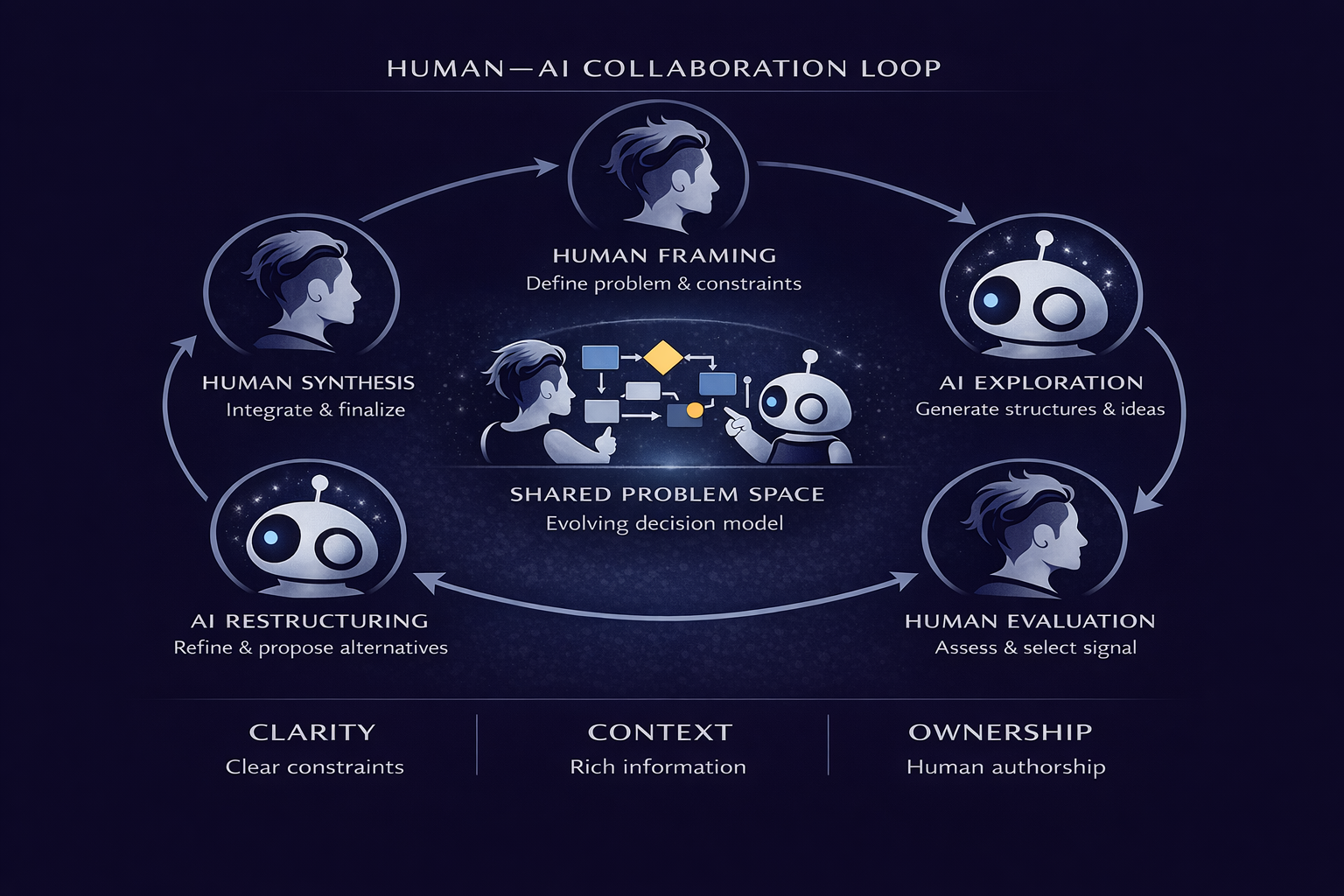
Over the past several months, I have worked extensively with AI systems while building analytical frameworks, portfolio artifacts, and research materials. Through that process I have developed a practical approach to collaboration that treats AI as a dialogue partner within a structured decision process.

In my experience, effective collaboration with AI tends to move through several stages. Different phases of work benefit from different styles of interaction. Sometimes a conversational exploration works best. Other times a directive, task-oriented prompt is more efficient. Learning when to shift between these modes improves both speed and clarity.

AI collaboration stages mirror many of the same processes used in research, strategy, and systems design.

  1. Clarifying the problem.

  2. Exploring possible structures.

  3. Iterative dialogue

  4. Evaluation and integration.

  5. Final authorship.

This process allows complex, ambiguous problems to be structured progressively until clear decisions can be made.

1. Clarifying the problem

Productive collaboration begins with precise problem definition. A conversational approach to working with AI is particularly useful in early-stage problem definition and in synthesizing complex material across domains.

This typically involves specifying:

  • the decision or question being explored

  • constraints and requirements

  • the intended format of the output

  • the broader context surrounding the task

Clear constraints dramatically improve the usefulness of AI responses and help prevent generic or overly polished outputs.

2. Exploring possible structures

Once the problem is defined, AI systems are often most helpful in organizing ambiguity quickly to propose coherent structures.

This may include:

  • outlining ideas

  • proposing alternative framings

  • organizing ambiguous material

  • suggesting ways to structure an argument or analysis

At this stage the goal is exploration rather than final answers.

3. Iterative dialogue

The most valuable insights tend to emerge through dialogue rather than single prompts.

Conversation allows ideas to be:

  • clarified

  • challenged

  • reframed

  • refined through multiple iterations

This process helps surface hidden assumptions and improves the clarity of both the problem and potential solutions.

4. Evaluation and integration

Human judgment remains central throughout the process.

AI systems frequently introduce assumptions, context gaps, or generic phrasing that must be corrected. Effective collaboration requires active evaluation of outputs and selective integration of useful elements into the final artifact.

The human remains responsible for:

  • deciding what stays or goes

  • refining language

  • maintaining coherence across the work.

5. Final authorship

Productive collaboration requires continuous evaluation:

  • distinguishing signal from noise

  • rejecting weak suggestions

  • refining promising directions

The final artifact is always shaped through deliberate human editing.

AI may accelerate exploration and synthesis, but authorship — including interpretation, judgment, and responsibility for the work — remains human. This ensures that decisions — not just outputs — reflect deliberate human judgment.

This is how I actually use AI in practice.

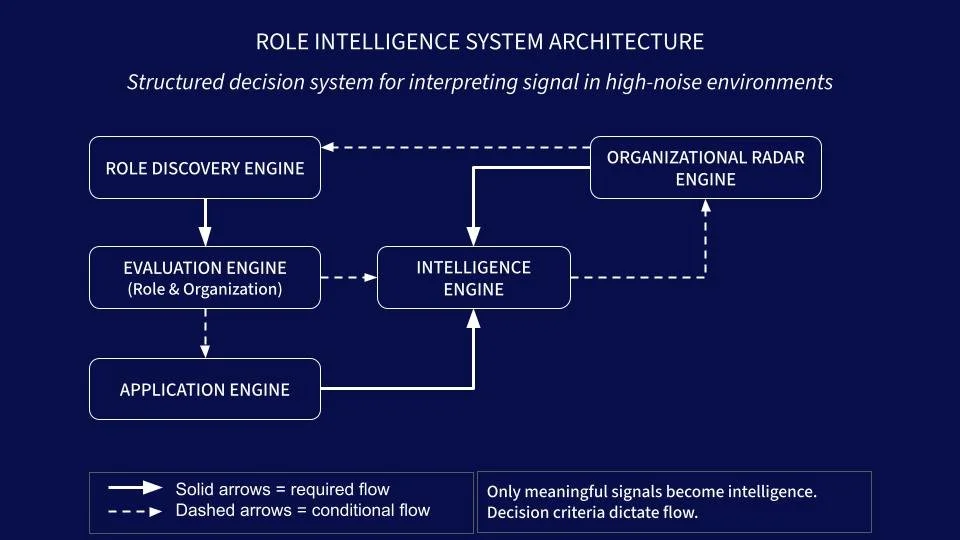
I pair structured prompts with a simple decision flow to move from signal detection to targeted outreach.

The goal isn’t strictly focused on automation — it’s building a system that improves how I interpret information and take action under uncertainty

What makes a dialogue-driven AI collaboration effective?

Across my extended work with AI systems, several patterns emerged that consistently improved outcomes.

Clear constraints produce better reasoning

Explicit requirements — scope, format, tone, and purpose — help guide the collaboration and prevent drift into generic output.

Context improves alignment

Providing rich contextual information allows AI systems to respond more accurately and consistently. When goals, background, and prior decisions are visible, AI responses are far more likely to align with the broader project. When context accumulates across conversations, including things like personal working style and voice, collaboration improves dramatically.

Iteration reveals insight

Although AI systems can surface possibilities quickly, meaningful insight rarely appears in the first response. Drafting, critique, and revision allow promising ideas to surface while weaker ones fall away.

This iterative process helps clarify assumptions and expose weak reasoning before decisions become embedded in finished work.

Not every task benefits equally from AI

Some forms of work benefit strongly from conversational exploration:

  • early conceptual development

  • synthesis across complex material

  • structural drafting

Other tasks often benefit from manual work instead:

  • precise diagram editing

  • detailed formatting

  • final editorial polishing

Recognizing when collaboration produces diminishing returns is part of effective use.

Thread management matters for complex work

Large drafting or synthesis tasks benefit from continuity of context. Keeping core work within a single conversation preserves evolving assumptions and decisions.

Exploratory thinking, planning, and reflection can often happen productively in parallel threads without disrupting the core artifact.

An important note on pacing

Energy management is part of productive AI collaboration.

Sustained work benefits from respecting cognitive phases.

Complex work like large synthesis tasks often move through stages such as:

  1. assimilation

  2. structural reasoning

  3. editorial execution

  4. integrity review

Allowing time for these phases to resolve produces better results than forcing premature completion.

From a human perspective, maintaining momentum without burnout requires pacing work realistically.

In my experience, structured iteration combined with occasional reflection — and even the occasional lighthearted sidebar — helps sustain creativity and analytical clarity over long projects.

The broader lesson

Using AI effectively is less about mastering a tool and more about strengthening core analytical skills:

  • precise problem definition

  • explicit constraints

  • careful evaluation of outputs

  • iterative refinement

  • integration of external input without losing authorship

These are the same skills required to design and operate decision systems in complex environments.

AI makes the reasoning process more visible — but the quality of decisions still depends on how that process is structured.