
How Living Frameworks Are Built
A method for constructing adaptive systems that improve decision-making under uncertainty.
Living Frameworks are not designed all at once. They are constructed through repeated interaction with the systems they are meant to support.
This page describes the method behind that construction — how signals are interpreted, decisions are structured, and systems evolve through feedback over time.
It is not a fixed process, but a way of building systems that remain aligned with reality as conditions change.
Living Frameworks operate as a shared construction method — expressed across different types of systems but built on the same underlying logic.
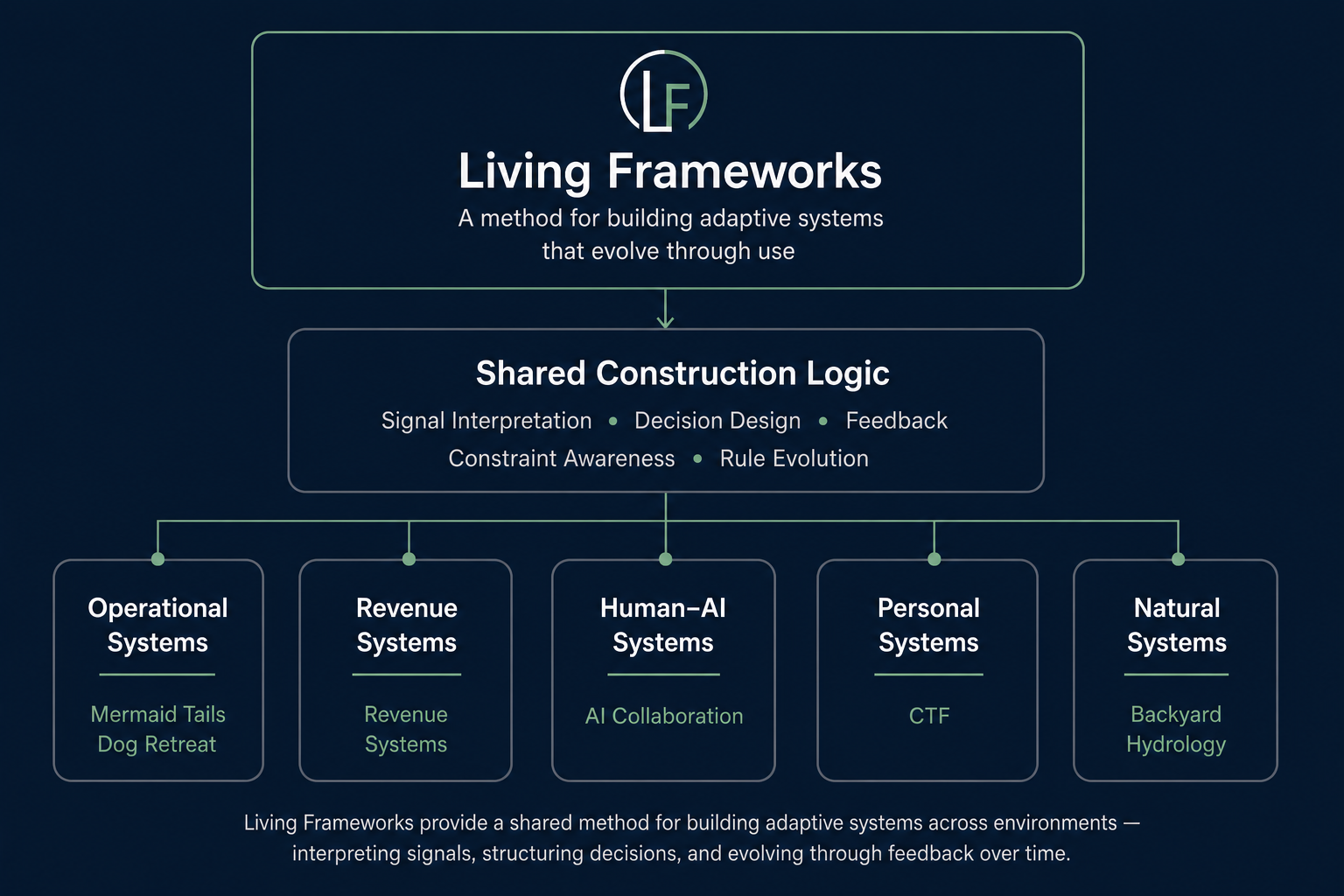
The sections below describe how this method is constructed and applied in practice.
Why A Method Is Needed
Understanding how adaptive systems behave is not enough to design them effectively.
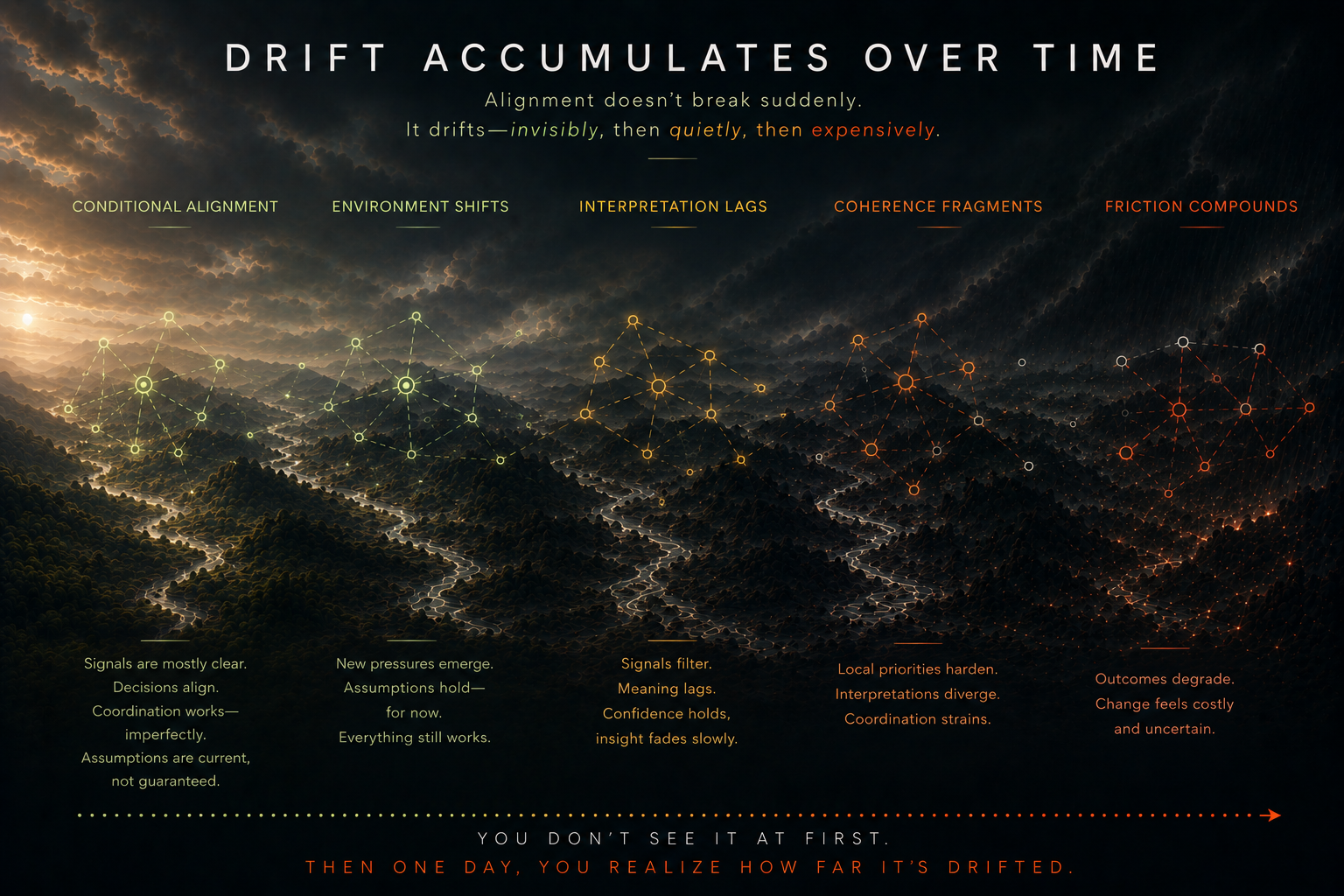
In practice, systems break down not because signals are absent, but because they are misinterpreted, delayed, or fragmented across the system.
Decisions are made against incomplete or distorted information. Feedback arrives too late to inform action. Subsystems adapt independently without coordination.
The result is not a lack of activity, but a loss of alignment — where systems continue to operate, but no longer respond accurately to the conditions they are meant to navigate.
These breakdowns are not isolated failures. They are consequences of how the system is structured.
Without a way to construct systems that interpret signals, coordinate learning, and adapt over time, even well-designed frameworks drift out of alignment.
A method is needed not to prescribe decisions, but to shape how decisions are made and how systems learn from the outcomes they produce.
Constructing Adaptive Systems
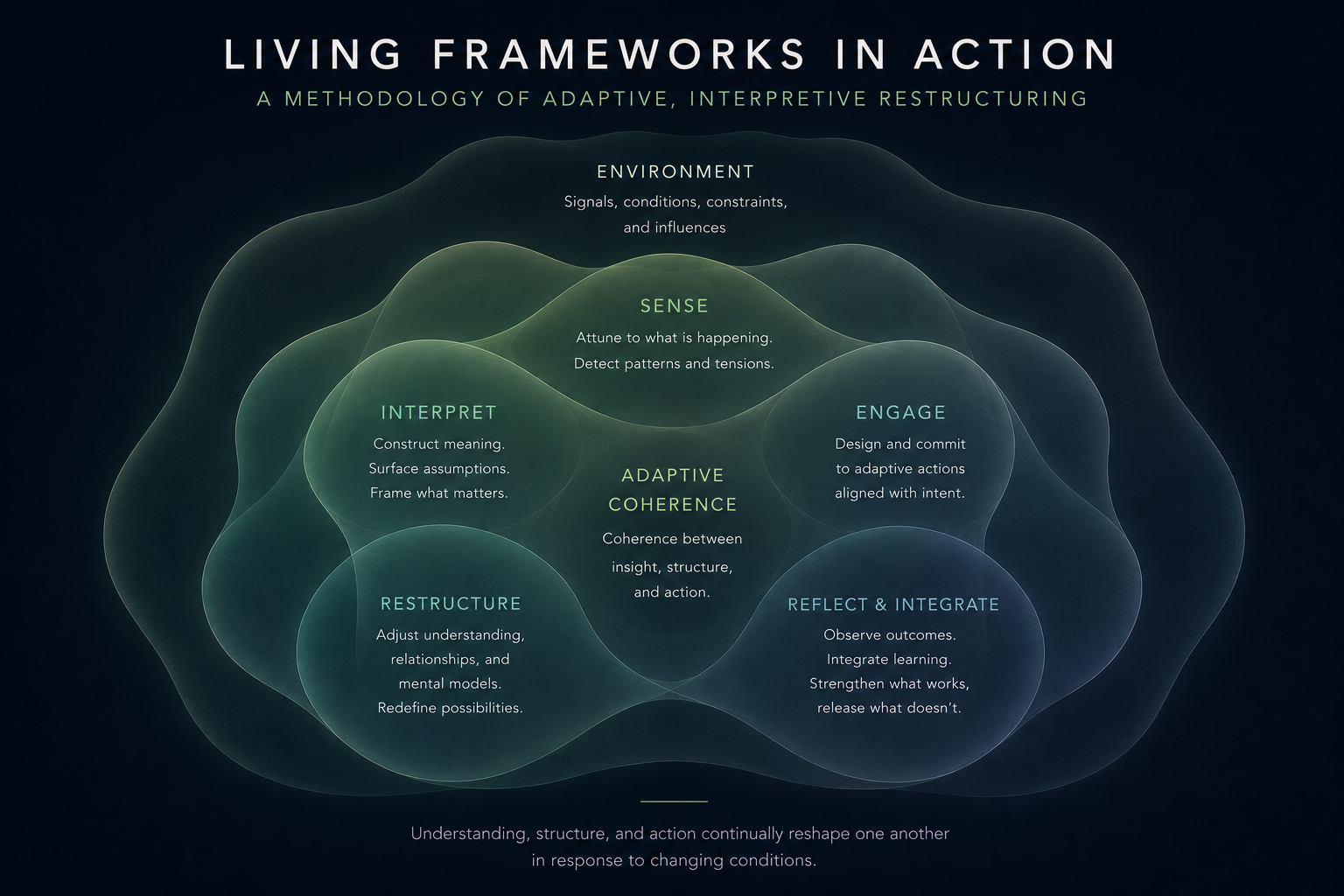
Building a Living Framework involves maintaining adaptive relationships between signals, interpretation, decisions, and system restructuring over time.
This structure does not operate as a fixed sequence. It emerges through interaction with the system, becoming more defined as signals accumulate and understanding deepens.
In practice, construction of Living Frameworks tends to organize around a set of interrelated elements:
identifying where decision pressure exists
clarifying the constraints shaping the system
defining what constitutes a meaningful outcome
forming hypotheses about what is driving current behavior
selecting actions that test those hypotheses
observing how the system responds
interpreting those responses as signals
updating the system’s underlying assumptions and decision logic
These elements do not occur once, or in isolation. They repeat, overlap, and evolve, forming a continuous structure for learning and adaptation.
What distinguishes this cycle is not the presence of these elements, but how they are connected. Each decision feeds into the next, and each outcome reshapes how future decisions are made.
Over time, this structure becomes the operating logic of the system — guiding how it interprets signals, coordinates action, and remains aligned with changing conditions.
How to Read the Cycle
This structure is not intended to be followed as a fixed sequence.
In practice, these elements are encountered unevenly. Some become clear early, while others only emerge through interaction with the system.
Multiple loops often operate at once. Different parts of the system may be forming hypotheses, taking action, and interpreting signals simultaneously.
As a result, construction is not linear. It is iterative, overlapping, and responsive to the conditions of the system.
What matters is not completing each element in order, but maintaining the connections between them — ensuring that decisions are informed by signals, and that outcomes are interpreted in a way that improves future decisions.
Over time, this process becomes more structured. Signals sharpen, assumptions are refined, and the system develops a clearer understanding of how to operate within its environment.
What Changes Over Time
As a Living Framework evolves, it does not simply repeat the same cycle.
The structure itself changes:
Signals become more precise — what was once ambiguous becomes interpretable.
Assumptions are tested and either reinforced or replaced — the system develops a clearer sense of what is driving outcomes.
Decision criteria become more defined — the system becomes more selective about which actions to take and why.
Relationships between subsystems become more visible — coordination improves as the system learns how different parts interact.
Over time, these changes accumulate into a form of system memory — not stored as static rules, but embedded in how the system interprets signals and makes decisions.
This is what allows a Living Framework to remain aligned with changing conditions. It does not rely on fixed knowledge, but on continuously updated understanding.
Where This Shows Up
This method is not tied to a specific domain. It applies wherever systems must interpret signals, make decisions, and adapt over time.
Living Frameworks are used to construct adaptive systems across different domains:
Operational systems — designing how organizations translate strategy into coordinated action.
Revenue systems — interpreting signals across acquisition, conversion, and retention to guide growth decisions.
Human–AI systems — structuring how reasoning unfolds through interaction between human judgment and AI exploration.
Personal systems — supporting individuals in navigating uncertainty through structured decision-making and feedback.
Natural systems — designing interventions that align with environmental constraints and feedback dynamics.
Each of these systems operates differently. What remains consistent is the underlying method — how signals are interpreted, decisions are structured, and systems evolve through feedback over time.
How This Evolves in Practice
The method described here provides a way to construct systems that remain aligned with changing conditions.
In practice, these systems are never finished. They are developed, tested, and refined over time — shaped by the signals they encounter and the decisions they produce.
Understanding the structure of the method is only part of the process. Its effectiveness depends on how it is applied, observed, and adjusted in real-world conditions.
This work documents that process — how Living Frameworks are built, tested, and evolved over time.