
Designing Living Frameworks
How adaptive systems work, where they break down, and what it takes to keep them aligned with reality.
How I Think About Adaptive Systems
Living frameworks are often described as flexible or adaptive. In practice, their usefulness depends on where they are applied—and how they are maintained.
This piece outlines:
where adaptive systems break down
how they fail in practice
what those failures reveal about designing for real-world complexity
Definition
A living framework is an adaptive system designed to interpret signals, maintain responsiveness, and evolve over time within complex and changing environments.
Design philosophy
Living frameworks should be designed to:
interpret signals
respond to changing conditions
maintain coherence across subsystems
evolve over time
Static frameworks assume stable conditions, clear signals, and predictable progression. In dynamic environments, these assumptions break down. Plans become obsolete, progress stalls, and systems struggle to adapt.
Living frameworks shift the focus from executing a plan to maintaining system health through observation, feedback, and calibration.
Example: Nested Systems in Practice
In career development, individuals operate within a broader labor market that continuously shifts. Signals from employers, industries, and technologies influence how individuals adapt their narratives, skills, and strategies. Over time, these adaptations compound, reshaping both individual trajectories and the broader system.
From Single Loops to Nested Systems
Most frameworks assume:
a single process
a single loop
a single level
But dynamic systems are structured differently.
They consist of multiple interacting adaptive processes operating across subsystems. At scale, these adaptations reshape the larger system itself.
Frameworks therefore must account for multiple interacting adaptive processes rather than a single linear progression.
At the individual level, multiple adaptive dynamics are constantly in motion:
job search efforts
narrative development
skill acquisition
These adaptive processes interact with larger system conditions:
Labor market shifts → Changes hiring signals → Individuals adapt narrative and strategy → Skills and experience compound → Career trajectories shift
Static vs Living Frameworks
Most frameworks are designed for stability. In dynamic environments, frameworks designed for stability break down. Plans become obsolete, progress stalls, and systems struggle to adapt.
Living frameworks take a different approach. They do not prescribe a fixed path. Instead, they organize how a system adapts. The goal shifts from executing a plan to maintaining the system’s ability to adapt.
Static frameworks
linear steps
fixed structure
control-focused
stable conditions
Living frameworks
interactive subsystems
adaptive
signal-driven
changing systems
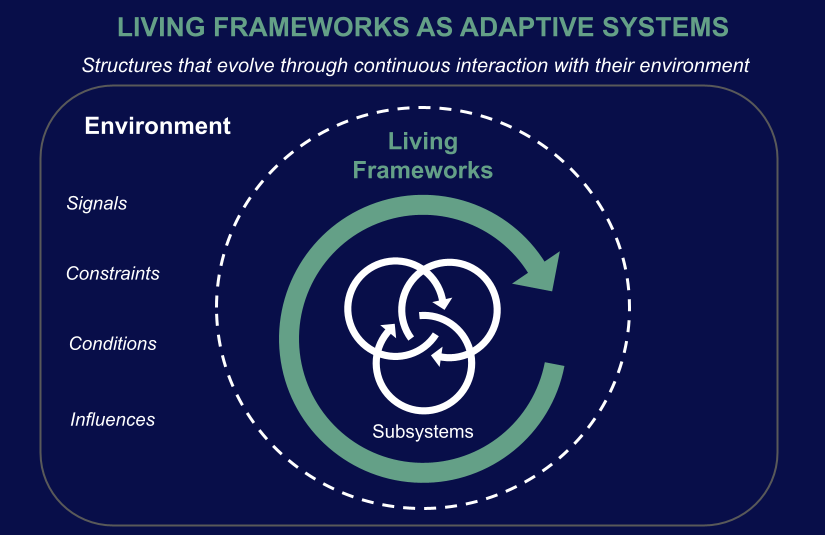
Figure: Structure of a Living Framework
Living frameworks operate as adaptive systems composed of interacting subsystems embedded within changing environments. Each subsystem interprets signals, responds to changing conditions, and adapts over time through feedback. These adaptive processes exist within broader environmental conditions that shape system behavior. As adaptations compound across subsystems, the framework itself evolves.
Adaptive Interaction Within Systems
At the core of living frameworks are adaptive processes through which systems interpret signals, respond to changing conditions, and restructure over time.
This unfolding process allows systems to remain responsive as conditions change.
Complex adaptive systems do not operate through a single process. They contain multiple adaptive processes interacting across subsystems.
In practice, these elements do not occur as discrete steps, but as overlapping dynamics that shape one another. What matters is not the presence of signals, but how they are interpreted — as this determines how the system adapts.
Systems Within Environments
These subsystems operate within a broader environment that:
generates signals
imposes constraints
evolves over time
The relationship is bidirectional:
environmental shifts influence system behavior
accumulated adaptations reshape the larger system
A living framework therefore functions as an adaptive system embedded within changing conditions.
What This Changes
Viewing systems through this lens shifts how problems are approached.
Instead of asking “What’s the plan?” the question becomes “What structure allows the system to adapt as conditions change?”
Instead of optimizing for a single decision, the focus shifts to the signals that guide decisions over time. Execution is not a linear process. Living Frameworks are designed to learn, continuously interpret feedback, and adjust in response.
This shift moves the focus from control to responsiveness, from prediction to alignment. And once systems are understood this way, the question is no longer just how they behave — but how to build them.
Boundary Conditions: Where Living Frameworks Break Down
Boundary Condition 1 — Stable Environments
Living frameworks are designed for dynamic systems.
When conditions are stable, static frameworks are often more efficient
Examples:
assembly line production
standardized manufacturing processes
regulated compliance procedures
safety checklists in aviation
In these cases: predictability through fixed sequencing is better than adaptation.
So one boundary condition becomes:
Living frameworks are most useful in environments where conditions change frequently.
Boundary Condition 2 — Clear Causal Systems
Some problems are mechanistic, not systemic.
Examples:
solving a mathematical equation
repairing a known mechanical fault
following a medical protocol for a routine procedure
These problems already have:
clear inputs
known causal relationships
predictable outcomes
In these systems, adaptive frameworks add unnecessary complexity.
Living frameworks address complex systems, not merely complicated ones.
Boundary Condition 3 — Immediate Control Contexts
Adaptive systems rely on learning cycles, which require time.
Some environments demand immediate control and rapid action.
Examples:
emergency response
crisis management
military operations in combat situations
critical infrastructure failure
In these cases, systems often shift temporarily into command-and-control structures. Once the crisis passes, adaptive systems can resume.
So another boundary condition is:
Living frameworks function best when the system has time to learn.
Boundary Condition 4 — Weak or Missing Feedback
Living frameworks depend on feedback loops. When signals are absent, delayed, or unreliable, learning breaks down.
Examples:
policy systems with decade-long feedback delays
environmental interventions with slow ecological responses
strategic decisions where outcomes emerge far in the future
In these cases the framework may still help structure thinking, but adaptation becomes slower and less reliable.
The principle here:
Signal quality determines the effectiveness of learning loops.
Boundary Condition 5 — Externally Constrained Systems
Some systems cannot adapt internally because they are constrained by external requirements.
Examples:
heavily regulated financial systems
legal procedures
standardized testing regimes
strict compliance environments
These systems prioritize consistency and fairness, which limits adaptation.
Living frameworks may still operate around these structures but cannot reshape them directly.
Boundary Condition 6 — Exploration-Dominant Environments
At the opposite extreme, some environments intentionally avoid structure to preserve exploration.
Examples:
early-stage artistic exploration
open-ended brainstorming
highly emergent creative communities
Living frameworks introduce coordination and adaptive structure —but in early exploration, structure can constrain what the system is trying to discover.
So the principle here becomes:
Living frameworks introduce structure only where it supports learning.
Failure Modes — How Living Frameworks Drift or Break
Even in the environments where living frameworks should work, they can still fail.
Living frameworks are designed to adapt through feedback. Yet the same mechanisms that enable learning can also produce failure when signals are distorted, loops become misaligned, or structural balance is lost. Understanding these failure modes helps clarify how living frameworks must be designed and maintained.
These failure modes differ not in whether signals exist, but in their quality: distorted, delayed, or absent.
Failure Mode 1 — Signal Distortion
A living framework depends on accurate signals from its environment. When signals become distorted, the system adapts in the wrong direction.
Distortion can occur through:
incomplete information
delayed feedback
incentives that hide or manipulate outcomes
selective attention to convenient data
In these cases, the framework still adapts, but it adapts toward a false understanding of reality.
Many organizational failures emerge from this condition: systems that optimize internal metrics while losing touch with external signals.
Failure Mode 2 — Feedback Delay
Adaptive systems depend on timely feedback. When the consequences of actions appear only after long delays, the system struggles to interpret cause and effect. Adjustments become guesswork rather than learning.
Examples include:
long product development cycles
ecological interventions with slow responses
strategic decisions whose outcomes emerge years later
In such environments, living frameworks must compensate by seeking proxy signals or shorter feedback cycles.
Failure Mode 3 — Loop Fragmentation
Living frameworks rely on multiple interacting adaptive processes. If these processes become isolated from one another, the system fragments.
This can occur when:
teams operate in silos
subsystems optimize locally without coordination
communication across parts of the system breaks down
Subsystems may continue adapting, but the overall system loses coherence. Local improvements may even damage the overall system.
Failure Mode 4 — Structural Rigidity
Living frameworks require structure, but when structure becomes overly rigid the system loses its capacity to evolve. This often happens when frameworks become institutionalized as doctrine rather than tools.
What began as an adaptive model becomes treated as a fixed rule. At this point the framework stops learning from reality and instead tries to force reality to conform to the model.
Failure Mode 5 — Excessive Fluidity
The opposite problem can also occur.
If the framework lacks sufficient structure, adaptation becomes chaotic. Signals trigger constant adjustment without coordination or direction. In this state the system never stabilizes long enough for learning to accumulate.
Healthy living frameworks balance structure and adaptability. Too much structure produces rigidity; too little produces drift.
Failure Mode 6 — Metric Capture
Systems often begin measuring signals in order to learn from them. Over time those measurements become targets rather than indicators.
When this happens, behavior shifts toward optimizing the metric itself rather than the underlying system health.
The framework continues to adapt, but it adapts to the measurement system instead of reality.
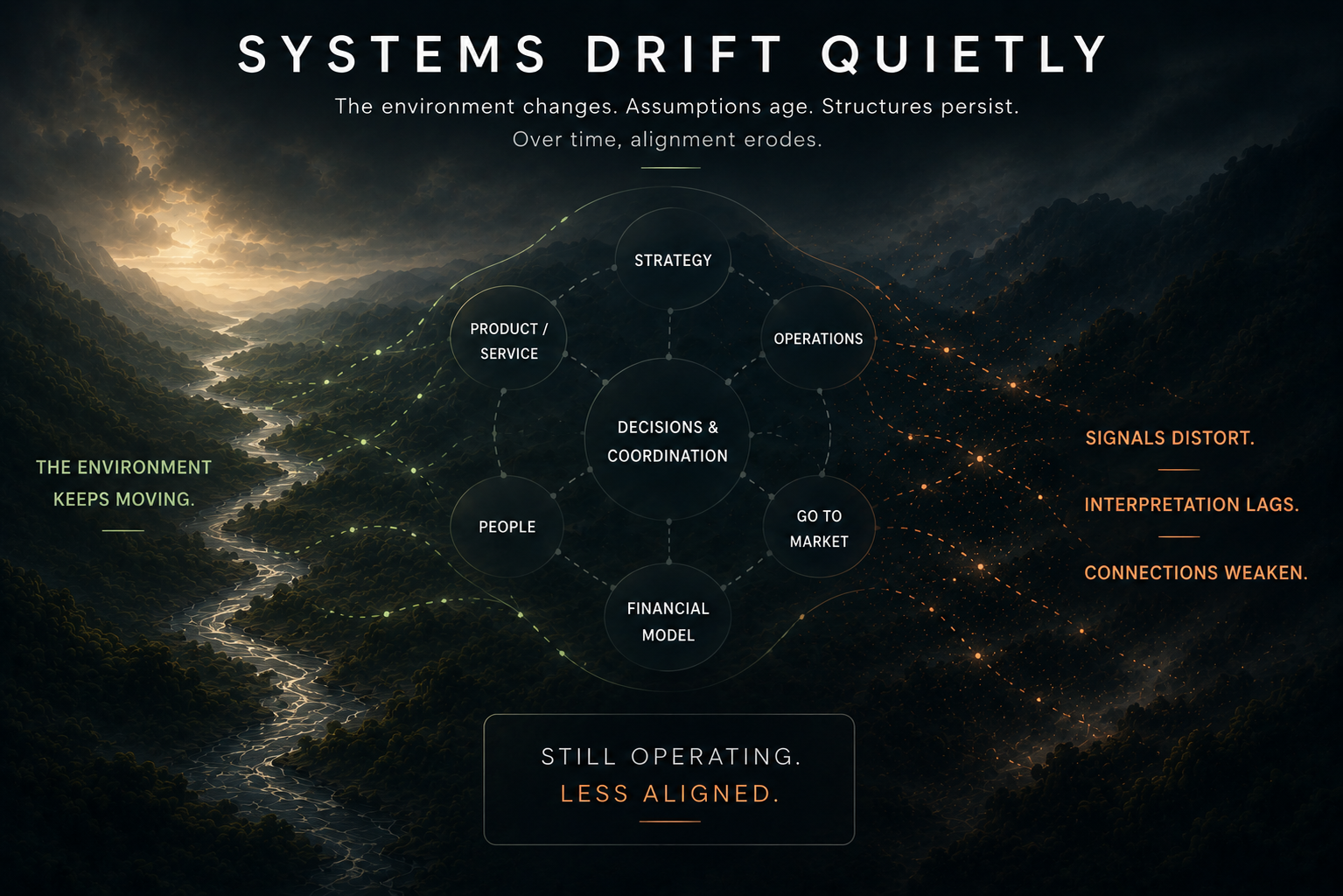
Failure Mode 7 — Environmental Misalignment
Finally, a framework may become misaligned with its broader environment.
Conditions change:
markets evolve
technologies shift
ecosystems transform
Even in dynamic environments (where living frameworks are needed), failure occurs when the system stops detecting change. If the framework fails to detect these shifts, it may continue optimizing patterns that no longer reflect the current system.
This failure mode is particularly dangerous because it often appears gradual rather than abrupt.
What these failures reveal
Each failure mode points back to the core design principles of living frameworks.
Healthy systems maintain:
accurate signal interpretation
timely feedback
coordination across subsystems
balance between structure and flexibility
awareness of changing environmental conditions
In other words, the same mechanisms that enable adaptation must themselves be continuously monitored.
Why this matters
Understanding failure modes reinforces an important idea: Living frameworks are not static designs that guarantee success. They are structures that support ongoing learning.
Like ecosystems, they must be observed, adjusted, and occasionally restructured as conditions change.
Their strength lies not in predicting the system but sustained alignment with a changing system.
What this means in practice
Designing adaptive systems is not about maximizing flexibility.
It is about maintaining alignment between signals, structure, and environment over time.
In practice, this means:
monitoring signal quality, not just outcomes
maintaining coordination across subsystems
adjusting structure without overcorrecting
detecting environmental shifts before they compound
The goal is not a perfect system, but a system that can remain in relationship with reality as it changes.